Road construction means orange barrels and annoying traffic for most. But for dozens of low-income residents of color along interstates 26 and 526, it means being forced to leave their homes. It means uprooting ways of life and an unknown fate, all in the name of growth, quantified later in a sterile press release from some faceless office.
Infrastructure projects have long been billed as a method of ensuring economic prosperity, even as communities of color disproportionately shouldered negative impacts. In the shadow of Jim Crow South Carolina, Interstate 26 and the Crosstown Expressway sliced through the Charleston peninsula, with postwar national highway policy encouraging the development of white-flight suburbs. Black families that thrived in the area where the Septima P. Clark Expressway now runs were paid a pittance and booted from their homes. Dead ends like Poinsett Street downtown stand as monuments to an insensitive policy with racist outcomes that divided and displaced communities across South Carolina and the U.S.
New policies have made it harder for neighborhood-shattering projects to get rammed through, but past ills still lurk as growth rears its head and infrastructure projects are planned across Charleston.
A project to widen Interstate 526 in North Charleston has the state highway department once again knocking on doors in the Highland Terrace, Liberty Park and Russeldale communities, already split by I-26 two generations ago. This time, about 100 more homes will be bought by the government and torn down — 94% of residents are Black, according to The Washington Post.
Historically, these projects advanced because Black communities represented “the point of least resistance” for regulators, one Liberty Park resident told the Post.
About seven miles south along I-26, residents of the majority-Black Rosemont community, already isolated by the interstate, could again be casualties of a sea wall project designed to protect the tourism district from storms.
While a $1 billion plan would wrap a sea wall around much of the peninsula, homes in Rosemont would get no such protection. The U.S. Army Corps of Engineers solution? “Nonstructural measures” that include floodproofing, raising buildings or outright buying (and presumably demolishing) flood-prone homes.
“My family has lived on the peninsula for years, and it seems like they just keep trying to push people further up and out,” Rosemont resident Errin Hane told the City Paper’s Skyler Baldwin this week. “We don’t want to leave, but I don’t know what else we can do.”
In West Ashley, Charleston County continues to push the I-526 extension project onto Johns and James islands, which means even more development pressure near historically Black sea island communities.
Federal Transportation Secretary Pete Buttigieg admits, “There is racism physically built into some of our highways.” The trillion-dollar infrastructure and jobs plans before Congress this week includes some funding as a lifeline for impacted communities.
But that’s not enough if South Carolina keeps planning for mindless expansion projects with no end in sight.
It’s up to local residents to be that resistance if they have the means. Engage at public meetings. Communicate with your elected officials. Don’t let this keep happening.
The president canceled a trip to Chicago in an attempt to salvage a pair of bills containing trillions of dollars in spending on infrastructure, education, climate change and more.
WASHINGTON — President Biden and his aides mounted an all-out effort on Wednesday to salvage Mr. Biden’s economic agenda in Congress, attempting to forge even the beginnings of a compromise between moderates and progressives on a pair of bills that would spend trillions to rebuild infrastructure, expand access to education, fight climate change and more.
Mr. Biden canceled a scheduled trip to Chicago, where he was planning to promote Covid-19 vaccinations, in order to continue talking with lawmakers during a critical week of deadlines in the House. One crucial holdout vote in the Senate, Kyrsten Sinema, a centrist from Arizona, was set to visit the White House on Wednesday morning, a person familiar with the meeting said.
Ms. Sinema was one of the Democratic champions of a bipartisan bill, brokered by Mr. Biden, to spend more than $1 trillion over the next several years on physical infrastructure like water pipes, roads, bridges, electric vehicle charging stations and broadband internet. That bill passed the Senate this summer. It is set for a vote this week in the House. But progressive Democrats have threatened to block it unless it is coupled with a more expansive bill that contains much of the rest of Mr. Biden’s domestic agenda, like universal prekindergarten and free community college, a host of efforts to reduce greenhouse gas emissions and tax breaks for workers and families that are meant to fight poverty and boost labor force participation.
Ms. Sinema and another centrist in the Senate, Joe Manchin III of West Virginia, have expressed reservations over the scope of that larger bill and balked at the $3.5 trillion price tag that Democratic leaders have attached to it. Moderates in the House and Senate, led by Ms. Sinema, have resisted many of the tax increases on high earners and corporations that Mr. Biden proposed to offset the spending and tax cuts in the bill, in order to avoid adding further to the budget deficit.
Mr. Biden has thus far failed to convince Ms. Sinema and Mr. Manchin to agree publicly to a framework for how much they are willing to spend and what taxes they are willing to raise to fund the more expansive bill. If Mr. Biden cannot find a way to address their concerns, while also assuaging progressives and persuading them to support his infrastructure bill, he could see the warring factions in his party kill his entire economic agenda in the span of a few days.
Some Democrats have complained this week that the president has not engaged in talks to their satisfaction, though he has cleared his schedule this week in hopes of brokering a deal. He welcomed groups of progressives and moderates to the White House last week, for example, but met with each separately, as opposed to a group negotiation session.
Both Ms. Sinema and Mr. Manchin visited the White House on Tuesday, but after their meetings, neither they nor White House officials would enumerate the contours of a bill they could support.
“The president felt it was constructive, felt they moved the ball forward, felt there was an agreement, that we’re at a pivotal moment,” Jen Psaki, the White House press secretary, told reporters on Tuesday, characterizing the meetings. “It’s important to continue to finalize the path forward to get the job done for the American people.”
White House officials said late Tuesday that Mr. Biden remained in frequent contact with a wide range of Democrats, including phone calls with progressives, and that he would have more conversations on Wednesday.
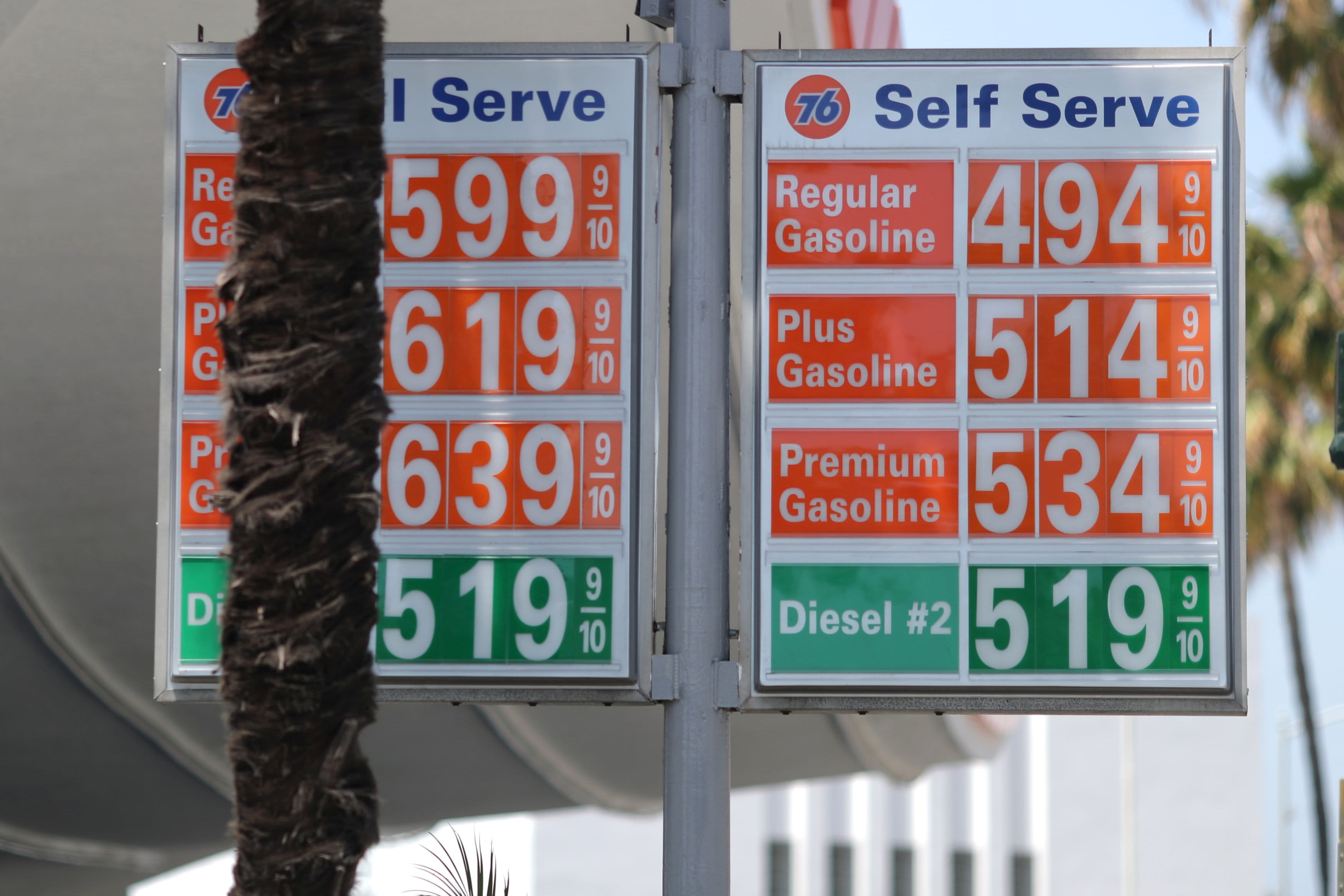
Gas prices are seen after U.S. consumer prices surged in April, with a measure of underlying inflation blowing past the Federal Reserve's 2% target, in Beverly Hills, California, June 2, 2021.
Lucy Nicholson | Reuters
Inflation expectations are still being driven by a "temporary spate of supply issues" and there is no sign of continued upward pressure on prices, according to veteran economist Carl Weinberg.
Global stock markets were roiled on Tuesday by a spike in bond yields which saw the benchmark 10-year Treasury yield touch a high of 1.567%.
Speaking to CNBC's "Squawk Box Europe" on Wednesday, Weinberg, chief economist at High Frequency Economics, said the global semiconductor shortage, bottlenecks at ports and Covid-19 impediments were a "temporary spate of supply issues" rather than systemic inflationary pressures.
"Inflation is a process and not a one-time change in the level of prices, which I think is what we're seeing right now," Weinberg said.
"We're seeing an adjustment to new temporary realities on the supply side but we're not seeing the stagflation process that we saw in the 1970s recurring again."
Stagflation refers to a situation first identified in the 1970s in which inflation is high, economic growth slows and unemployment remains consistently high. The problem for economic policymakers in such an instance is that measures to curb inflation, such as wage and price controls or contractionary monetary policy, may further increase unemployment.
Weinberg said he did not yet see a basis for such a scenario, adding: "This is not 1973."
While acknowledging that a "large segment" of the market believes that inflation will be persistently higher, which in turn is driving up bond yields, Weinberg argued that there are many other factors keeping the U.S. economy imbalanced, "not least of which is Covid."
"With so many Americans resisting vaccination, that will continue to be a problem, and a brake on the economy, for a very, very long time. The chip problem has no short-term solution to it, the supply bottlenecks at the port don't have a short-term solution," he said.
He argued that this was not the Fed's fault and that "supply and demand will rebalance," meaning prices will stop rising "after a certain point."
"We're just going through a really rough patch right now as we reopen the economy at a pace never before seen, after a closure that we've never seen before, and we're getting some unexpected bumps along the way," Weinberg said.
"I'm not sure though that you can add that up into a story that says that beyond the immediate reopening, that we're going to see continued upward pressure on prices."
Adam Copeland, Darrell Duffie, and Yilin (David) Yang
A concern of the Federal Reserve is how to manage its balance sheet and whether, over the long run, the balance sheet should be small or large. In this post, we highlight results from a recent paper in which we show how, even during a period of “ample” reserves, the Fed’s management of its balance sheet had material impacts on funding markets and especially the repo market. We argue that the Fed’s “balance-sheet normalization” from March 2017 to September 2019—under which aggregate reserves declined by more than $950 billion—combined with post-crisis liquidity regulations, stressed the intraday management of reserves of large bank holding companies that are active in wholesale funding markets resulting in higher repo rates and spikes in such.
Background
Before the 2007-09 crisis, the Fed provided a small aggregate supply of reserves, typically under $50 billion. This was sufficient for banks to manage their intraday liquidity demands and for wholesale funding markets to function with reasonable efficiency. With the Fed’s crisis facilities and post-crisis quantitative easing programs, aggregate reserves increased substantially, hitting $2.8 trillion in 2014.
By itself, such a large increase in reserves would make it easier for banks to manage their intraday liquidity constraints and provide funding to others. But as part of post-crisis regulatory reform, the Fed also introduced several liquidity requirements that provided incentives for large bank holding companies to hold substantial reserve balances at the Fed throughout each day. The level of reserves necessary to maintain liquid funding markets and meet intraday payment needs was difficult to determine.
What Do Repo Rates Tell Us About the Level of Reserves in the System?
To answer this question, we examine the impact of reserve balances on wholesale financing transactions in which U.S. Treasuries are posted as collateral. In the United States, these trades are overwhelmingly documented as repurchase agreements (Treasury repos). In an efficient funding market, arbitrage would essentially equate overnight Treasury repo rates with the overnight interest rate offered by the Fed on balances held at the Fed (IOR). As a result, our metric for funding market stress is the spread between overnight Treasury repo rates and IOR.
Rather than consider how changes in aggregate reserves correlate with this repo spread, we focus on the reserves held by the ten largest repo-active bank holding companies, which we call “dealer banks.” These dealer banks hold substantial balances at the Fed and are active participants in repo markets. As a result, these dealer banks trade off the benefits of holding their reserve balances at the Fed to meet their intraday payment needs and lending reserves to repo market participants.
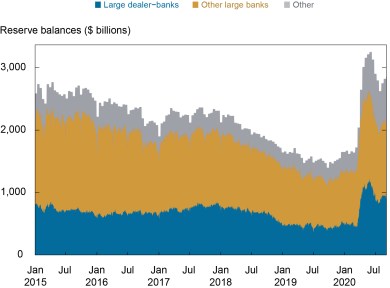
The chart below shows the total amount of Fed balances held by the ten dealer banks and illustrates the relatively low total level of Fed balances in mid 2019. The chart also demonstrates the concentration of reserves in the system; the largest 100 bank holding companies (BHCs) maintain the vast majority of balances held at the Fed. During our sample period, the ten dealer banks account for roughly 40 percent of Fed balances held by the top 100 BHCs.
Balances Held at the Fed Declined from 2017 to September 2019
Source: Fedwire Funds Service, FRED (RESBALNS).
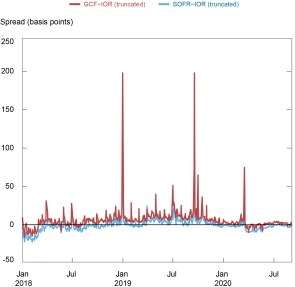
Focusing on late 2018 and 2019, when Fed balances were lowest, the next chart illustrates that Treasury repo rates as a spread to IOR generally remained positive and frequently spiked upward. This suggests that reserves were often in sufficiently low supply that BHCs were unwilling to invest their reserves in repo except to earn repo rates far above IOR. As a point of comparison, after the Fed vastly increased reserves in response to the COVID-related market disruptions in March 2020, the spread between the Treasury repo spread and IOR collapsed to essentially zero and spikes in repo spreads no longer occurred.
Repo Rates as a Spread to IOR Were Positive in 2019 and Spiked Upward Frequently
Source: Federal Reserve Bank of New York and Fixed Income Clearing Corporation.
Note: GCF is General Collateral Finance Repo rate; SOFR is the secured overnight financing rate, and IOR is the interest rate paid by the Fed on reserves. Both spread plots are truncated at 200 basis points for improved visualization.
Why Don’t the Dealer Banks Invest More Reserves Into Repo When Rates Are High?
Holding reserves as Fed balances benefits dealer banks beyond earning IOR, by helping them to manage their intraday liquidity demands to meet their regulatory liquidity requirements, and to maintain the bank’s reputation with supervisors for maintaining high levels of liquidity.
A major driver of a BHC’s intraday liquidity is its payments operations. BHCs both send and receive payments throughout the day as part of their normal operations. As documented in this article, to help manage their balances, banks often delay sending payments until they have received some offsetting payments. This cross-bank complementarity in payment timing, documented in this Liberty Street Economics post and this New York Fed Staff Report, was significant even in the post-crisis regime of ample reserves. A main driver of the timing of payments is the aggregate amount of aggregate balances. Delaying outgoing payments in reaction to incoming payments also suggests strategic complementarity across banks in their payment timing, which exacerbates systemic liquidity stresses when reserve balances are low.
We argue, with strong support from the data, that intraday liquidity demands combined with post-crisis liquidity regulations and supervision drove dealer banks to pull back from investing reserves into the repo market whenever their balances were at lower levels. This resulted in higher repo rates and more frequent repo rate spikes. These spikes were especially pronounced in mid-September 2019, when reserves balances reached their lowest levels during the balance-sheet normalization period. The most powerful single explanatory variable in our data for the spread between repo rates and IOR is a measure of the delay in incoming payments to the dealer banks.
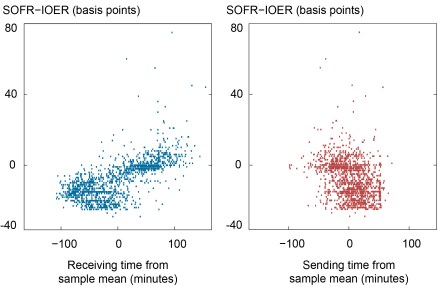
When facing a delay in payments received, dealer banks, unlike other typical large banks, do not simply delay their outgoing payments. Rather, we find that dealer banks tend to maintain their outgoing payments even when their incoming payments are delayed. This may be due to hard intraday payment deadlines related to capital market activities, such as payment for Treasury auction settlements. This dynamic is captured in the chart below, which shows that the daily average timing of payments received by the dealer banks varies between -100 and 100 minutes from its sample average. In contrast, the daily average timing of payments sent by the dealer banks varies between -50 and 50 minutes (compare the range of values along the horizontal axis of both panels).
Dealer Banks Face an Intraday Squeeze When They Receive Payments With a Delay
Source: Fedwire Funds Service and Federal Reserve Bank of New York.
Note: SOFR is the secured overnight financing rate. IOR is the interest rate paid by the Fed on reserves.
Because dealer banks tend to continue to send payments without delay, even when experiencing delayed incoming payments, they can face a squeeze on their intraday liquidity when system total balances are low. As a result, reserves held as Fed balances are more valuable to them under these conditions, and so are likely to require significantly higher rate compensation when invested into repos. This is captured in the left panel of the chart above—greater delays in payments received by the dealer banks are associated with higher repo rates and spikes in repo rates.
This intuition is captured more formally in our paper, where, among other results, we show that a one-standard-deviation delay in the time by which dealer banks receive half of their daily payments (58 minutes) predicts an 8.2 basis point elevation in the repo rate over IOR, after controlling for other effects. Furthermore, we show that these payment delays are associated with a greater likelihood of repo rate spikes when dealer-bank total reserve balances are low.
Takeaways
Our results imply that, under the structure of short-term funding markets of recent years, only with a substantial total amount of reserve balances are the dealer banks able to avoid intraday liquidity stress and provide efficient levels of liquidity to wholesale funding markets. Because the Fed responded to the March 2020 COVID pandemic with huge asset purchases, the total amount of reserves is at an all-time high. Nevertheless, the Fed’s past expressed preferences for balance sheet “normalization” may at some point in the future again raise tensions over the appropriate minimum level of aggregate reserves.
This raises potential alternative policy approaches for the Fed, among them:
Maintain a balance sheet that achieves clearly abundant reserves, with a focus on the resulting quantity of reserve balances held by the dealer banks.
Establish a standing repo facility (SRF), which would offer financing to a subset of repo market participants at a rate slightly above IOR. This administrative rate would prevent significant increases in market repo rates above IOR. Indeed, the Fed announced a SRF on July 28, 2021.
Adjust post-crisis liquidity rules and supervision, with the goal of decreasing the incentives of large banks to maintain thick intraday buffers of reserve balances during periods of liquidity stress.
Offer greater incentives for banks to utilize the Discount Window for backstop funding.
Adam Copeland is an assistant vice president in the Federal Reserve Bank of New York’s Research and Statistics Group.
Darrell Duffie is the Adams Distinguished Professor of Management and Professor of Finance at the Stanford Graduate School of Business.
Yilin (David) Yang is a Ph.D. candidate at the Stanford Graduate School of Business.
How to cite this post: Adam Copeland, Darrell Duffie, and Yilin (David) Yang, “Reserves Were Not So Ample After All,” Federal Reserve Bank of New York Liberty Street Economics, September 29, 2021, https://ift.tt/3B7JIM5
Disclaimer The views expressed in this post are those of the authors and do not necessarily reflect the position of the Federal Reserve Bank of New York or the Federal Reserve System. Any errors or omissions are the responsibility of the authors.
SEOUL, Sept 29 (Reuters) - South Korea’s central bank on Wednesday nominated an economist with expertise in macro-economic policies to join the bank’s seven-member board, as it considers further policy tightening to shift away from pandemic-era monetary settings.
Park Ki-young, 50, replaces Koh Seung-beom, who left the board in early August to head the Financial Services Commission regulatory body.
Park will serve until April 20. 2023, when Koh’s term was due to end.
The appointment, whose term is expected to begin soon, comes as the bank is trimming its pandemic-era stimulus as price pressures build and as policymakers worry household debt could become unsustainable, hurting people’s purchasing power and long-term growth.
Many market participants have expected Governor Lee Ju-yeol to tap someone with hawkish footing, as Koh was one of the most hawkish members on the board who argued the BOK should hike rates to address growing financial imbalances.
Park was briefly a BOK official in 1999 before he pursued further studies at The University of Maryland in the United States.
The Bank of Korea raised its policy rate by 25 basis points to 0.75% in August, the first hike in almost three years and the first major Asian central bank to shift away from pandemic-era monetary stimulus.
Reporting by Cynthia Kim, Editing by Louise Heavens
NEW YORK--(BUSINESS WIRE)--Understand why COVID-era shortages in the “global supply chain” and available workforce mean family groceries may cost so much more? Why you can’t find those new track shoes or that new video game console for months? Any clue what a $28 trillion national debt means for a student’s future?
It pays to understand economics – even at a young age.
October marks the first-ever National Economic Education Month – a series of activities to focus attention on helping K-12 teachers and their students understand the importance of economics.
“Education is fundamental to leveling the playing field,” said Nan J. Morrison, president and CEO of the Council for Economic Education (CEE), which is spotlighting the premiere of Economic Education Month at its 60th national Financial Literacy and Economic Education Conference. “With gaps in financial knowledge and wealth-building running clearly along socioeconomic lines, we must reach out to all students to help them understand how both personal – micro - and national and global – macro – economics impact just about every aspect of their lives.”
“Economics is all around us,” said Mike Raymer, executive director of the Georgia Council on Economic Education, which spearheaded the new national monthly designation. “Economics teaches us that scarcity forces everyone to make choices, and our choices come with costs. Students with a clear understanding of basic economic principles will be equipped to make educated decisions.”
CEE, its state affiliates and the National Association of Economic Educators are backing the monthlong effort to help teachers, school officials and policymakers bring economic education to life, noting that preparing children for success in life involves teaching them when they are young. Yet, as noted in CEE’s most-recent biennial Survey of the States, only 23 states require a standalone high school economics class be taken.
Among the activities this month:
Teachers can find free K-12 economics lesson plans and other classroom resources at CEE’s EconEdLink.org, take part in statewide events like the Georgia Council’s teacher video competition, and invite community and business leaders to classes to share how they consider economic choices when making decisions just as families do
Teachers, students and those who support this mission can enjoy exploring “economics in the real world” through various online activities and social media including following the conversation on Twitter with #EconEdMonth
“We treat every month like Economic Education Month,” Morrison added, “but we are eager in this special month to help everyone celebrate and learn about the abundant resources available to assist teachers and enable students to make optimal decisions for themselves, their families and their communities throughout their lives.”
ABOUT THE COUNCIL FOR ECONOMIC EDUCATION: The Council for Economic Education’s mission is to teach K-12 students about economics and personal finance so they can make better decisions for themselves, their families and their communities. We carry out our mission by providing resources and training to K-12 educators and have done so for over 70 years. Nearly two-thirds of the tens of thousands of teachers we reach virtually and in-person are in low to moderate income schools. All resources and programs are developed by educators and delivered by our nearly 200 affiliates across the country in every state. We also advocate for more and better education in personal finance and economics, primarily through CEE’s biennial Survey of the States. Find out more at councilforeconed.org.
Want the lowdown on European markets? In your inbox before the open, every day.
Sign up here.
Modern monetary theorists shouldn’t expect a warm welcome in Paris: according to a
working paper by Bank of France economists, their ideas are “more of a political manifesto than of a genuine economic theory.”