'It's like being for puppies'
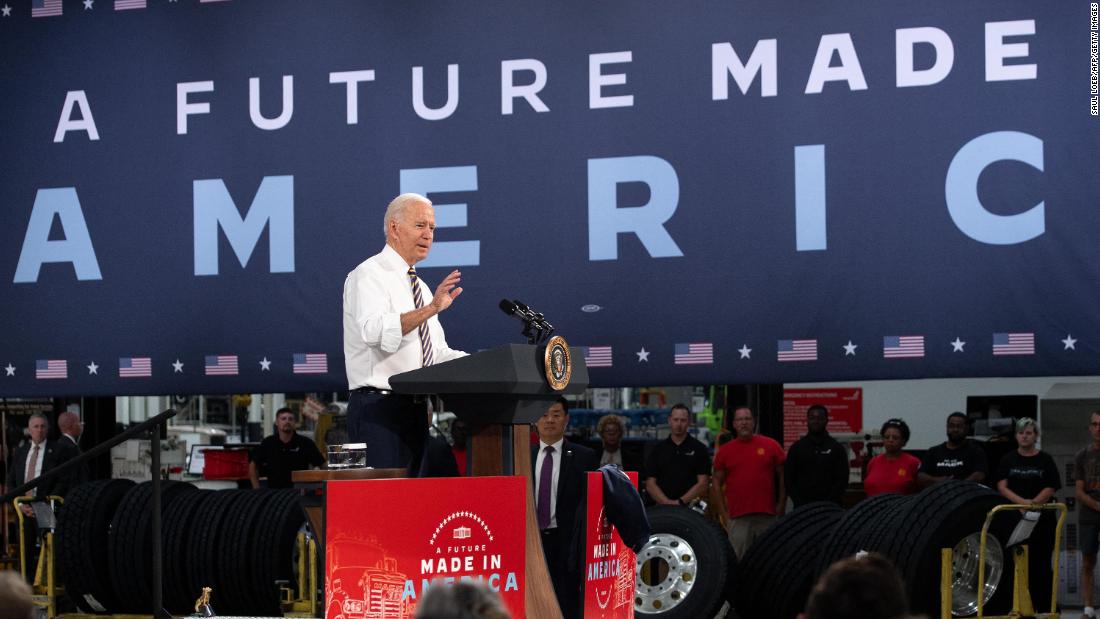
Biden's Buy American push is good politics but bad economics - CNN
Read More

[unable to retrieve full-text content]
What really counts? How the patriarchy of economics finally tore me apart The Guardian
Sign up for the New Economy Daily newsletter, follow us @economics and subscribe to our podcast.
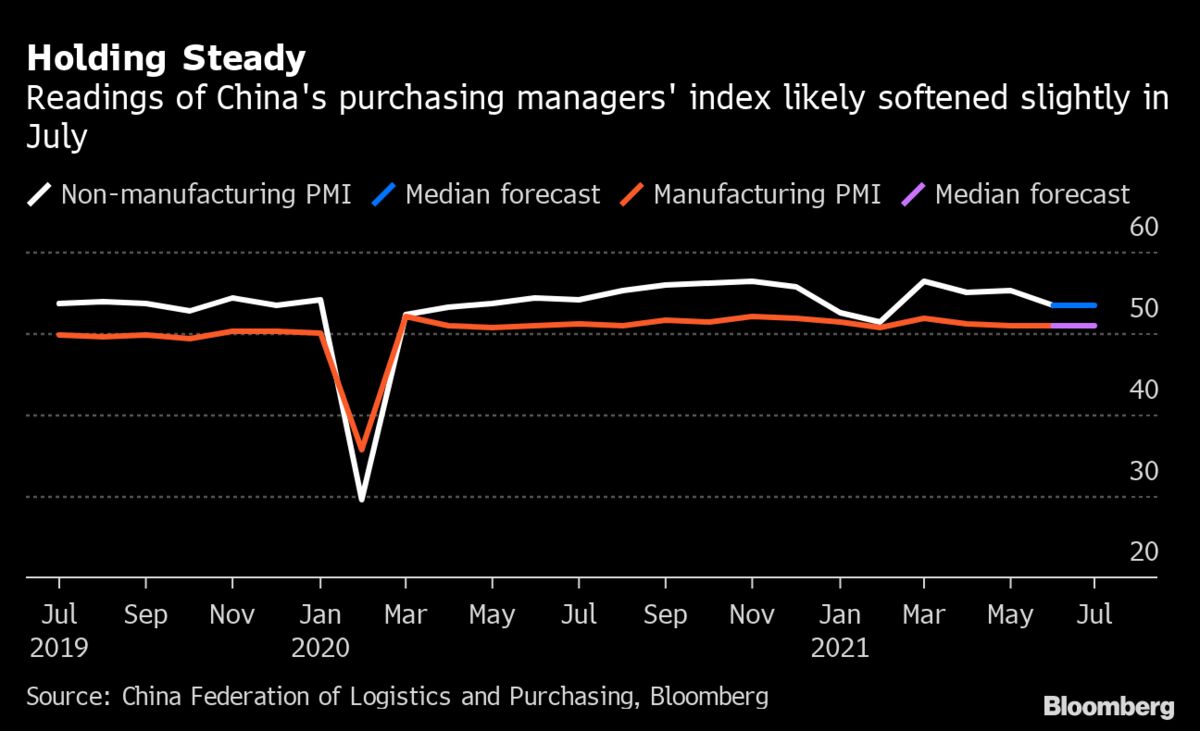
China’s economic activity continued to ease in July, implying a more steady recovery into the second half of the year as growth risks mount.

On Thursday, the White House issued an impromptu, last-minute call for Congress to extend an expiring moratorium on evictions nationwide, citing the renewed threat of the delta variant. That effort was not expected to pass and its late arrival frustrated liberal lawmakers and advocates close to the administration. Even some White House officials were confused by the sudden statement from White House press secretary Jen Psaki, which appeared incompatible with the congressional schedule. The moratorium ends Sunday, leaving lawmakers virtually no time to meet Psaki’s request.
“Why are we doing this now? Why did we wait so long? It’s very weird,” one senior administration official told The Washington Post, speaking on the condition of anonymity to reflect the mood among many officials.
The whiplash over the eviction moratorium underscores the broader uncertainty facing the administration as it tries to head off the delta variant as the other parts of its economic agenda proceed.
Even within 24 hours, the administration received deeply conflicting signs about the progress of its efforts.
On Wednesday, the White House and Senate Republicans announced they had secured a breakthrough agreement on a $1 trillion bipartisan infrastructure package, a key priority of the president’s. Thursday morning, the Department of Labor reported weekly unemployment claims had stayed relatively flat in a troubling sign of the economic rebound. Government data released Thursday also showed surging growth, with the economy growing by 6.5 percent in the quarter ending in June, while closing the gap created by the pandemic.
The eviction moratorium expiring Sunday highlighted the challenges of adjusting to the delta variant on such a rapid timeline.
The White House official in charge of implementing the stimulus, Gene Sperling, raised the idea in internal conversations over the past week of whether the moratorium could be extended unilaterally, two people familiar with the matter said. White House Domestic Policy Council Director Susan Rice and National Economic Council Director Brian Deese were also involved in discussions about extending it and supportive of the effort, the people said.
However, their suggestion ran into opposition from the White House Office of Legal Counsel, among other administration attorneys, who cited a Supreme Court opinion last month, the two people said. In voting with the court’s liberals to allow the moratorium to remain in place through July, Supreme Court Justice Brett M. Kavanaugh said that extending the moratorium further would require congressional approval.
Biden administration attorneys expressed concern that if the White House defied Kavanaugh, the Supreme Court could move to restrict other emergency public health rules instituted by the federal government, the people said. The people spoke on the condition of anonymity to discuss internal dynamics.
“There was a real desire to go back and kick the tires and say, ‘Are we absolutely sure we can’t extend?’ Everybody wanted to as a policy matter. But what was clear from the legal analysis was that we had already litigated this issue all the way to the Supreme Court, and the court had spoken on the issue,” Sperling told The Washington Post. “There was no chance of winning or it even having a temporary positive impact and some chance that it could provoke a harmful ruling.”
Still, Sperling’s explanation leaves unclear why the White House waited a month — between Kavanaugh’s June 29 opinion and Psaki’s statement on Thursday — to push for congressional action. The delay complicated legislative efforts to keep the ban in place. Two House Democrats involved in the push for extending the moratorium, who spoke on the condition of anonymity to discuss internal matters, said they had been waiting for guidance from the administration, before trying to push the effort through Congress.
The statement also said Biden would have “strongly supported” an extension in the eviction moratorium amid the delta variant were it not for the Supreme Court’s announcement. A White House statement stressed that the landscape of covid-19 had shifted rapidly since the time of the court’s ruling. The statement also emphasized the administration’s efforts to accelerate disbursal of rental assistance relief across the country.
The White House has cited strong economic growth and falling unemployment, and said it has always maintained the war against covid had not been fully won. A White House statement pointed to new efforts over the past several months to improve the pace of vaccinations and said the economy would receive further support from parts of the $1.9 trillion stimulus yet to be allocated.
Other advocates maintained the administration should have moved more quickly on the eviction moratorium. An analysis circulating among congressional Democratic offices found that millions of renters are at risk of eviction precisely in the areas where the delta variant is most strongly circulating.
“The ruling the Supreme Court gave was based on arguments filed in early June, when delta made up about 10 percent of cases. Now, delta is about 90 percent of cases and everything is surging,” said Paul Williams, a housing expert and fellow at the nonprofit Jain Family Institute and the author of the analysis.
“Why not instruct the CDC to extend it and let this go through the courts? Every day the rental assistance program can send out money and extinguish debt is evictions prevented.”
Some housing experts agreed with the White House, saying they believed that the administration’s hands were tied by the Supreme Court.
“The delta variant changed everything and created new urgency for an extension,” said Diane Yentel, president and CEO of the National Low Income Housing Coalition. “But the Supreme Court was really clear that if they attempted to extend the moratorium they would overturn it.”
Other analysts said the criticism of the administration is overblown. The economy is still set to grow at a rapid pace and much of the country is vaccinated. It remains far from clear whether the delta variant remains a long-term threat — even if that possibility continues to be a top concern of administration officials themselves.
“I think this is being overplayed,” said Dean Baker, a liberal economist. Baker pointed to a sharp decline in cases in the United Kingdom after an initial surge as a reason to be heartened. “The reality is they did a very good job getting the vaccines out.”
Still, other challenges loom. The White House has been consumed this month with pushing Congress to approve the infrastructure package and a separate $3.5 trillion spending bill. But even though the labor market remains far from fully healed, federal unemployment benefits for roughly 9.2 million Americans stand to expire in full in September, according to a recent analysis by the Century Foundation, a think tank.
Biden has been clear that he believes it is time for the additional federal $300 per week supplement to end. But another 5.2 million gig workers and other self-employed Americans are set to lose their unemployment altogether given that a special pandemic unemployment program will expire in September. Another approximately 4 million Americans are also at risk of losing long-term federal unemployment benefits.
A White House statement said the administration was still evaluating new data and pushing Congress to implement long-term reforms of the unemployment system. The White House has not answered questions about whether it will seek to extend the jobless program for gig workers and the long-term unemployed. One senior administration official said White House officials believe there is no political will on Capitol Hill for extending those benefits.

Despair in American society is a barrier to reviving our labor markets and productivity, jeopardizing our well-being, health, longevity, families, and communities—and even our national security. The COVID-19 pandemic was a fundamental shock, exacerbating an already a growing problem of despair.
This despair in part results from the decline of the white working class. It contributes to our decreasing geographic mobility and has political spillovers, such as the recent increase in far-right radicalization. At the same time, other population groups are also suffering, for different reasons. Over past few years, for instance, suicides increased among minority youth and overdoses increased among Black urban males (starting from a lower level than whites but now exceeding it).
Policy responses have been fragmented, with much focus on interdiction or ex-post treatment rather than on the root causes of despair. There are local efforts to boost the well-being of vulnerable cohorts, but most are isolated silos. There is no federal level entity to provide the vulnerable with financial or logistical support, nor is there a system that can disseminate relevant information to other communities seeking solutions. While federal agencies—such as the Centers for Disease Control (CDC)—track mortality trends, no system tracks the underlying causes of these deaths. In contrast, many countries, such as the U.K. and New Zealand, track trends in well-being and ill-being as part of their routine national statistics collection and have key leadership positions focused exclusively on these issues.
This policy paper proposes a new federal interagency task force to address our nation’s crisis of despair as a critical first step to sustainable economic recovery. The task force would both monitor trends and coordinate federal and local efforts in this arena. We identify five key areas the task force could monitor and help coordinate: data collection; changing the public narrative; addressing community-wide despair as part of the future of work; private-public sector partnerships; and despair as a national security issue.
Facebook has the resources to put up a hefty court fight. It reported $29 billion in revenue in the most recent quarter and has a market value of about $1 trillion. | Jeff Chiu/AP Photo
The lead economics expert in the Federal Trade Commission’s antitrust suit against Facebook has parted ways with the agency, two individuals familiar with the case said — adding yet another impediment to the regulator’s largest court fight.
The FTC is now looking for a new expert, just three weeks before the agency must decide whether to file the new version of the Facebook lawsuit after a D.C.-based judge threw it out last month.
The expert, University of California-Berkeley economist Carl Shapiro, didn’t respond to multiple phone calls and an email asking the reasons for his departure. But he has criticized new FTC Chair Lina Khan’s aggressive approach to antitrust enforcement, and she in turn has faulted the agency’s traditional reliance on economists’ analyses in its fights against alleged monopolists.
The agency hired Shapiro, a former Obama-era antitrust official, to aid in its suit against Facebook in 2019. It has already paid out $5.7 million to the economics consulting firm where he is a senior consultant, according to a POLITICO analysis of federal contracting data. That is nearly double what the FTC has paid for any other expert services over the past two years at a time the agency has told Congress it is strapped for cash.
While the FTC retains any work Shapiro and his associates have completed, experts said much of the work will need to be redone by any new economic team hired by the agency in order to adequately defend it in court.
That’s on top of a growing pile of headaches for the FTC as it attempts to press its case against Facebook and pursues an antitrust probe of Amazon — both of which rank among the five most valuable U.S. companies. The two tech giants have demanded that Khan recuse herself from their cases, prompting an internal debate on how the FTC should respond, and she faces attacks from GOP lawmakers who accuse her of sidelining the agency’s two Republican commissioners.
The agency declined to comment on Shapiro’s departure.
“The FTC does not comment on internal deliberations over any particular expert engagement,” spokesperson Lindsay Kryzak told POLITICO. “But the agency routinely reviews its expert support needs, including to ensure that the agency is making the best use of limited public funds while carrying out its law enforcement obligations.”
The agency sued Facebook in December, alleging the company monopolized the social networking market by buying up Instagram and WhatsApp and cutting off data access to other potential rivals. A federal judge threw out the FTC’s complaint last month, finding prosecutors didn’t show Facebook controls more than 60 percent of the market. The agency has until Aug. 19 to file a new complaint.
The FTC has also been seeking a replacement for Shapiro, the top antitrust economist at the Justice Department in both the Obama and Clinton administrations and a well-known figure in antitrust litigation. He has served as the testifying expert in six FTC or DOJ cases over the past eight years, including the Trump-era Justice Department’s failed bid to stop AT&T’s merger with Time Warner and an unsuccessful attempt by state attorneys general to block Sprint and T-Mobile from merging. He also consults for Google.
Kryzak, the FTC spokeswoman, declined to comment on how much the agency has spent on expert witnesses.
The agency has pleaded with Congress for more money, arguing that its $331 million budget isn’t sufficient for its burgeoning workload of policing mergers, business conduct, consumer privacy and data security. In financial reports, the agency has cited ballooning expert witness costs as among its “top risks.”
The individuals who spoke to POLITICO didn’t know the reason for Shapiro’s exit and whether it related to disagreements about the future of the case, the costs or the history of ideological differences between Shapiro and Khan. The individuals requested anonymity to speak about internal agency deliberations.
Shapiro has been critical of Khan’s approach to antitrust, particularly her view that enforcers focus too heavily on a so-called consumer welfare standard that emphasizes price as the main sign of a lack of competition. (Critics of the tech industry say the standard is ill-suited to handling companies like Facebook and Google that offer their main products free of charge to consumers.)
In a conversation with reporters on June 28, Khan said previous antitrust enforcers relied too heavily on economic analysis to make their cases. She cited the states’ challenge to the Sprint-T-Mobile merger — in which Shapiro testified on behalf of the attorneys general — where the judge said the dueling economic experts “essentially cancel each other out” and required him to tell the future from “competing crystal balls.”
“Antitrust over the last few decades has become dependent on a particular type of economic theory,” Khan said. “The antitrust statutes are quite sparse. They are very general. There’s nothing in there about what econometric analysis to use. There’s been choices about what types of analysis to privilege.”
Two other individuals familiar with the agency’s Facebook case defended the amount of money the FTC has spent so far, noting that monopolization cases like the one against the social network are notoriously expensive. It also isn’t unusual for a new chair to seek to replace top staffers or experts in high-profile cases to better align with their priorities, one of the people said. Both spoke anonymously to discuss internal agency dynamics.
In a 2019 audit, the FTC’s inspector general found the agency pays about $750 per hour for experts and that cases involving company business conduct — like the antitrust suit against Facebook — are among the most expensive. Of the 15 contracts the inspector general audited, conduct cases accounted for $6 million of the $20 million spent.
The investigators recommended the FTC seek to use its in-house economists as expert witnesses in more cases.
Facebook, meanwhile, has the resources to put up a hefty court fight. It reported $29 billion in revenue in the most recent quarter and has a market value of about $1 trillion.
The FTC denied a public records request from POLITICO in February seeking information on expert witness contracts related to the Facebook case, saying its disclosure would interfere with the agency’s litigation. But using public data that the FTC reported to a federal government contracting database, POLITICO was able to identify the expert witness contract related to Facebook.
In the fiscal year that ended on Sept. 30, the FTC spent $21.3 million for expert witness services. So far this fiscal year, the FTC has already spent $25 million, according to federal government contracting records. The amounts paid vary between a few thousand dollars and several million depending on the work required. The $5.7 million contract is by far the largest, nearly double the amount of any other contract the agency has paid for expert witness services.
“The quantity of information both data and documents that experts have to review, use and assimilate has grown astronomically over time and that has caused expert costs to rise,” said Bruce Hoffman, who served as the FTC’s top competition staffer from 2017 through 2019.
The FTC does some of the work in-house but doesn’t have the computing power or infrastructure needed to take on all of it, said Hoffman, now a partner at the law firm Cleary Gottlieb.
Most of the expenses are probably not from Shapiro himself — who offers the government a discount on the rate he charges to corporate clients — but from the Charles River Associates colleagues assisting him. The individuals assisting Shapiro standardize data provided by companies in the investigation and do the economic calculations Shapiro requests. CRA bills the agency for the hours worked by Shapiro and its employees.
The contract terms between a consulting firm and its experts vary, but Shapiro would be paid for the time he worked plus a percentage of his assistants’ total billings, probably somewhere between 10 and 25 percent, according to two economic consultants who asked to speak anonymously to discuss what both the agency and the consulting firms consider confidential billing practices.
Both consultants said they were surprised at the amount the FTC had spent so far given that the Facebook case is just beginning. The most expensive part of antitrust litigation usually takes place later in a case, when experts prepare written reports that can run into the hundreds of pages. Those expert witness reports, which are filed in court, can cost between $1 million and $2 million to prepare, they said.
While any new expert the FTC hires could reuse the data that Shapiro and his team compiled, the consultants said, that person would insist on redoing the economic analysis to be able to defend it in court.
But Hoffman, who left the agency before the Facebook case was really underway, said he wasn’t surprised by the expense.
“It’s a complicated case. I could imagine there’s mind bogglingly large quantities of data,” he said. “There’s a little bit of irony that people all over the country are screaming that the FTC should be more active and on the other hand concerned it’s spending too much money. If you want the FTC to be active, you have to give them the money to do that.”

Sign up for the New Economy Daily newsletter, follow us @economics and subscribe to our podcast.
China’s factory conditions likely stabilized in July, implying a more steady recovery in the economy in the second half of the year as growth risks mount.
AJC - Logo - Main logo_ddn_tag_Site JN with T...